
Roman shades are generally better when you want decorative fabric, visible texture, and a soft appearance. Roller shades are generally better when you prefer a flat profile, compact raised position, and easier surface cleaning.
Neither option is automatically better for privacy, blackout, or insulation. Those results depend on the fabric, liner, measurements, mounting position, and gaps around the window.
When comparing these shades for a customer’s window, we first look at how the room is used. A decorative living-room window may benefit from a Roman shade, while a frequently operated office or bedroom window may be better suited to a roller shade.
What Is the Difference Between Roman and Roller Shades?
The main difference is how the fabric moves.
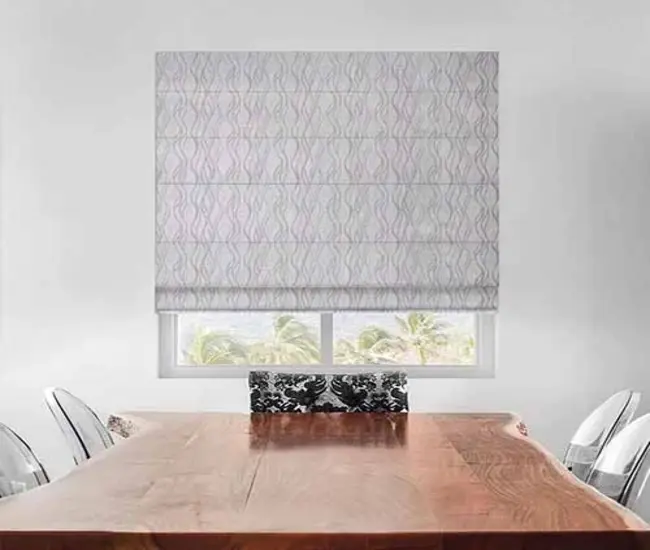
Roman shades lift into horizontal folds that remain visible at the top of the window. This creates a softer, layered appearance.
Roller shades use a flat fabric panel that wraps around a tube. Most of the material is stored around the tube when the shade is raised, creating a smaller and less noticeable stack.
This structural difference affects their appearance, cleaning requirements, operation, and suitability for large windows.
Roman Shades vs. Roller Shades at a Glance
| Attribute | Roman shades | Roller shades |
|---|---|---|
| Appearance | Soft, tailored and decorative | Clean, flat and minimal |
| Raised position | Fabric folds remain visible | Fabric rolls around a tube |
| Fabric choices | Decorative textiles, patterns and liners | Decorative and performance fabrics |
| Light control | Determined by fabric, liner and fit | Determined by opacity, fit and edge gaps |
| Cleaning | Folds may require more attention | Flat fabric is generally easier to dust |
| Large windows | Fabric can become heavy | Often more practical for wide windows |
| Motorization | Available on compatible designs | Commonly available |
| Best use | Design-focused rooms | Frequently used or streamlined spaces |
Which Shade Looks Better?
Choose Roman shades when the window treatment should become part of the room’s décor. Choose roller shades when you want the treatment to blend into the window.
Roman shades add visible fabric, texture, and depth. Flat Roman shades provide a tailored appearance, while relaxed or hobbled designs create fuller folds. They work well in rooms where fabrics, upholstery, and decorative details are important.
Roller shades have a flat surface and clean lines. They are commonly selected for contemporary interiors, offices, media rooms, and spaces where a compact window covering is preferred.
A cassette, fascia, or valance can conceal the roller tube and mounting hardware for a more finished appearance.
Which Provides Better Light Control?

Both Roman and roller shades can provide effective light control when made with the correct material and properly installed.
A light-filtering fabric reduces glare and softens daylight. Room-darkening and blackout materials block substantially more light through the fabric.
However, even blackout material may allow light to enter around the shade’s edges.
Inside-mounted roller shades commonly have side gaps because the fabric is narrower than the complete bracket-to-bracket width. The space is needed for the operating components.
If reducing light leakage is important, consider:
- An outside mount with sufficient overlap
- Blackout fabric
- Side channels designed for the shade system
- A light-blocking cassette specifically designed for the shade system
- Curtains layered over the shade
Roman shades can also have light gaps, particularly when installed inside the frame. A properly measured outside-mounted Roman shade may provide additional coverage, but it should not be assumed to create complete darkness.
For more targeted solutions, see these methods to fix light gaps around roller blinds.
Which Provides Better Privacy?
Privacy depends primarily on fabric opacity rather than whether the shade is Roman or roller.
Opaque and blackout fabrics generally limit visibility through the material when the shade is lowered. Actual privacy also depends on edge gaps, window exposure, and the difference between indoor and outdoor lighting.
Sheer and loosely woven fabrics may allow silhouettes or interior details to become visible at night when the lights are on.
For bedrooms, bathrooms, and street-facing rooms, examine the material against a bright light before ordering. A fabric sample can help you evaluate color and texture, but it should also be tested for visibility under daytime and nighttime lighting conditions.
In bathrooms and other humid rooms, verify that the selected fabric and components are suitable for the expected moisture conditions.
If you want natural light during the day and stronger privacy at night, consider layering the shade with curtains or choosing a material designed for greater privacy.
Which Shade Insulates Better?
Neither shade should be selected for insulation based on its style alone.
Thermal performance depends on:
- Fabric thickness and construction
- Blackout or thermal lining
- Gaps around the window treatment
- Inside- or outside-mount installation
- Condition of the window
- How consistently the shade is opened and closed at appropriate times
A lined Roman shade creates an additional fabric layer across the window, but its folds do not guarantee better insulation. A closely fitted roller shade with an appropriate fabric may also help reduce direct solar heat and create a barrier at the window.
If insulation is the main objective, compare both products with cellular shades. Their honeycomb construction traps air within the cells and generally provides better insulation than standard Roman or roller shades.
Which Is Easier to Clean?
Roller shades are generally easier to maintain because their fabric remains flat when lowered.
Many roller-shade materials can be dusted with a microfiber cloth, soft brush, or vacuum brush attachment. Certain performance fabrics can also be spot-cleaned according to their care instructions.
Roman shades contain folds, seams, and sometimes liners or decorative trim. Dust can settle along the folds, and delicate materials may require more careful cleaning.
Material remains important. A delicate roller fabric may be harder to clean than a durable Roman-shade material. Always follow the manufacturer’s instructions before applying water, detergent, steam, or cleaning products.
Which Is Better for Large Windows?
Roller shades can be practical for wide or frequently used windows when the selected fabric, tube, control system, and hardware support the required dimensions.
The material wraps around a tube instead of collecting in folds. This creates a compact raised profile and can make regular operation more convenient.
Roman shades become heavier as their width, height, and fabric volume increase. A large Roman shade may require a stronger control system or multiple individual shades.
Before ordering either option, verify:
- Maximum available dimensions
- Fabric weight limitations
- Mounting depth
- Control location
- Motor compatibility
- Whether multiple shades will create visible gaps
Which Is Better for Motorization?
Roller shades are commonly available with motorization, although compatible Roman shades can also be motorized.
Motorized roller shades are useful for tall, wide, or difficult-to-reach windows. Multiple compatible shades may also be programmed for coordinated operation.
Motorized Roman shades require the fabric folds to lift and stack correctly. Shade dimensions, fabric weight, fold style, and motor capacity must all be compatible.
Before purchasing, confirm the power source, remote options, wall controls, smart-home compatibility, and available manual override.
Which Shade Costs More?
Neither style is always more expensive because pricing depends on the window dimensions, fabric, construction, control system, and optional features.
Roman-shade pricing can increase with premium textiles, custom folds, liners, decorative trim, and motorization. Roller-shade pricing can increase with performance fabrics, large dimensions, upgraded tubes, cassettes, side channels, and motorized controls.
Compare both treatments using the same window dimensions and similar light-control and operating features.
See the separate guide explaining how much roller shades cost for a complete cost breakdown.
Which Shade Should You Choose?
Choose Roman shades if:
- You want a soft or tailored appearance.
- The fabric should complement other room textiles.
- You prefer visible texture and folds.
- You do not mind more involved cleaning.
- The shade will serve as a decorative feature.
Choose Roller shades if:
- You prefer a clean, compact profile.
- The shade will be operated frequently.
- Easier cleaning is important.
- You are covering a large window and a compatible roller system is available within the manufacturer’s size limits.
- You want a compact motorized system compatible with the window dimensions.
- You want the treatment to blend into the surrounding décor.
Before deciding, evaluate the room, window dimensions, mounting space, fabric opacity, privacy requirements, and frequency of operation. Order free fabric samples or contact Blanca I. Martinez team at Affordable Blinds at (800) 863-6109 for help comparing suitable options.