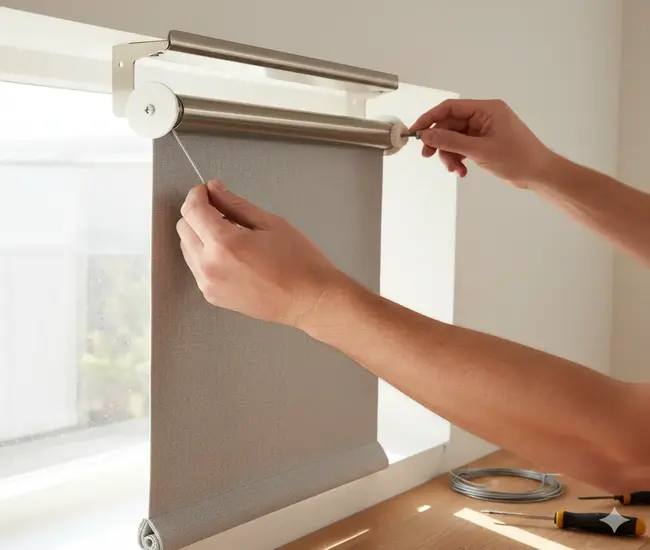
Are your spring-loaded rollers too lumpy and loose, and don’t roll up or stay up? It’s a clear sign your roller blinds need to be tightened. When your roller shade’s spring becomes fully uncoiled, there will be no tension in the spring-loaded roll-up mechanism. Resultantly, your blind won’t roll back again once it is extended, requiring immediate retightening.
This step-by-step how-to guide will walk you through the steps to repairing springs that are too loose, too tight, or just fully uncoiled. Tightening the spring tension will allow your roller blinds to be rolled up or down smoothly and positioned precisely.
Roller shades lose their spring tension for various reasons. Loss of spring tension can be a normal wear and tear.
However, physical damage, use of brutal force when operating, and more frequent use can speed up loosening of the roll-up mechanism.
Here is a quick tip. If your blinds don’t roll up, just roll them by your hand to help get the tension spring working properly again.
If the blinds are too slow, start with a lowered fabric, and then roll up halfway before putting back on the wall. Do the exact opposite when your shades roll up too quickly.
If loose roller window treatments are making you tense, read on to learn about practical DIY tips to tighten or adjust them.
What Are Roller Blinds?

Roller blinds – also known as roll-up shades or ‘rollers’ – are affordable and easy-to-operate fabric window coverings.
Based on the control mechanism, there are two types of rollers: (1) standard roller blinds with a cord or chain to raise or lower the fabric and (2) cordless spring-tensioned roller blinds with a spring-loaded control mechanism.
Spring-tensioned rollers contain a coiled spring inside of their hollow top tube. There is a tensioned clutch mechanism that locks the fabric in place when engaged. So, you can raise or lower the blinds to the desired level by pulling gently on the blind.
What is Spring Tension?
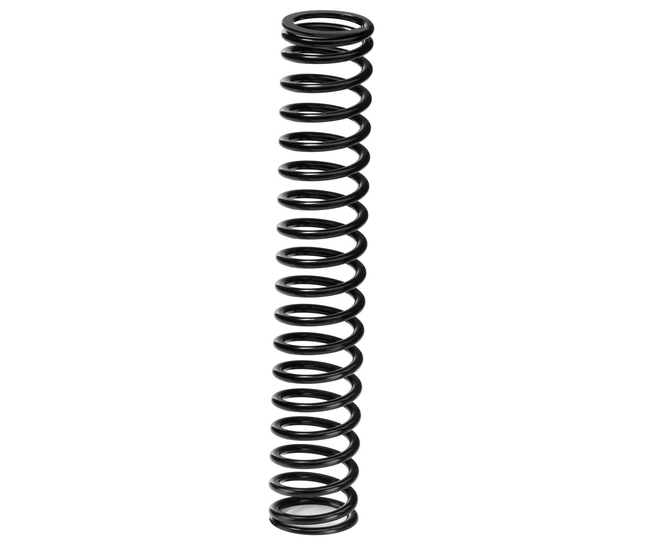
Spring tension is the potential energy that fuels a spring to return to its original position after it has been stretched or compressed. This tension is crucial for the overall performance of your spring-loaded roller blind.
Springs are designed with a specific tension level, based on the size and weight of the fabric you’ll be required to pull up when operating roller window attachments. In certain cases, you may need to increase their tension, for example, when optimizing their functionality. However, you must avoid excessive tension, as it can lead to total spring failure or even safety hazards.
3 Factors Affecting Spring Tension
Spring Length – Longer spring will have more material to stretch or compress, leading to higher tension, and vice versa.
Number of Coils – More coils means greater tension, and vice versa.
Spring Material – Different materials have different elastic properties. For example, Young’s Modulus for mild (low carbon) steel is around 200GPa, while that of copper is 110 to 130 GPa. So, steel is more elastic and less susceptible to deformation, making it a better choice for springs.
Tools & Materials You’ll Need
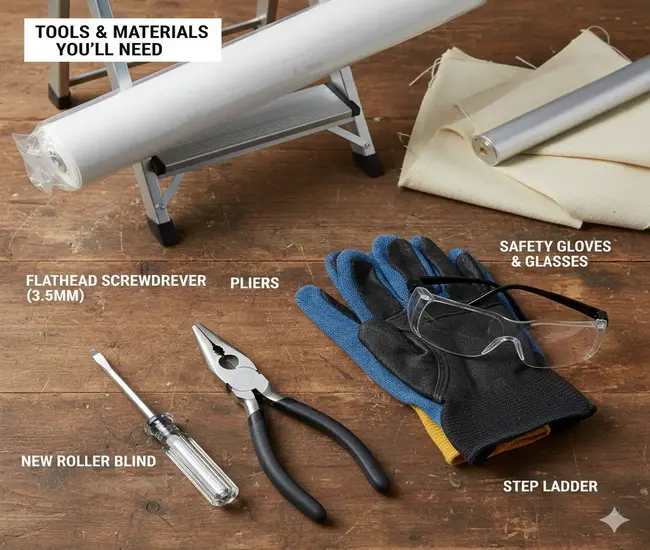
- A flathead screwdriver, preferably with 3.5mm head, to unscrew and rescrew roller tube caps and any internal parts
- Pliers (to turn the pin on the spring side of the blind)
- Step ladder (optional – if your blind is installed high on the wall)
- New roller blinds (optional – if old ones have reached their lifespan)
- Personal safety equipment – gloves, glasses, etc.
Method 1 (Steps to Increase Tension on Cordless Spring-Loaded Roller Blinds)
Tension spring
Step 1: If the blind is too loose, remove it from brackets and roll up by hand to increase tension.
Step 2: Reinstall it back in the window and the process until desired tension is achieved.
Step 3: If your roller blind is too tight or won’t stay down, take it down.
Step 4: Roll the fabric down halfway by hand. Make sure to roll the shade evenly on the tube.
Step 5: Put it back in the window.
Step 6: Keep repeating the same process until desired tension is achieved.
Pro Tip
The coiling direction (clockwise or anticlockwise) has an impact on the spring tension. Whenever a DIYer trying to restore the tension of their cordless spring loaded roller blinds contacts us for guidance, the very first thing we suggest is changing the spring direction from clockwise to anticlockwise, and it works in most cases.
Method 2 (How to Tighten Cordless Cassette Roller Blinds)
Step 1: If your cordless cassette roll-up blind is too loose, use a flathead screwdriver to tighten or loosen the screw to adjust and obtain desired spring tension.
Step 2: Test the level of tightness by raising or lowering the fabric.
Step 3: Repeat the above steps until your rollers obtain the desired level of tension.
Method 3: (How to Adjust a Fully Uncoiled Spring in Spring-Loaded Roller)
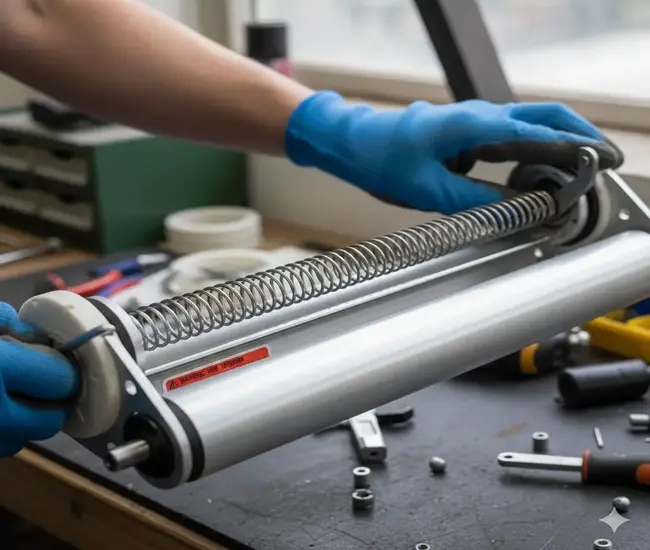
Step 1: Take down the blind from the mounting brackets.
Step 2: Unroll the fabric halfway.
Step 3: Turn the pin on the spring side of the window cover until you feel tension.
Step 4: Back off so the latch (that allows movement in only one direction) hooks onto the ratchet.
Step 5: If spring is locked in the coil, twist the pin clockwise to free the pawl (latch) and release the spring.
Step 6: Tighten or loosen the spring tension to the required level.
Pro Tip
Springs with a larger diameter resist deformation and have a higher tension. So, if your blind’s roller tube allows more space, install a new spring with a 2-3” larger diameter.
Note
If none of the above methods works, or you are unsure about the appropriate method or lack the necessary tools, we highly recommend seeking professional assistance. Professional engineers have the knowledge, expertise, & precision to provide tailored solutions for increasing spring tension.
Want to Permanently Fix Your Spring-Powered Roll-up Blinds?
If your roller window covers have reached their lifespan, the DIY tips above won’t solve your problem. You’ll need to shop for their replacements.
Budget-friendly roller blinds with sturdy cordless controls are available with various functional models, such as light filtering, blackout, & sheer roller blinds. If you are looking for an ultimate luxury, consider a motorization upgrade.
Safety Considerations When Working with Your Roller Blinds’ Spring Mechanism
Protective Gear – Always wear safety glasses and gloves to prevent injury to your eyes and hands, in case of flying debris or accidental contact with tensioned spring.
Manufacturer’s Guidelines – Before handling or modifying springs, carefully read and follow the manufacturer’s guidelines for the correct use of tools and techniques for the specific spring model.
Regularly Inspect Spring-loaded Mechanism – Look for the signs of wear or damage to springs or associated parts to prevent failures or accidents.
OSHA Laws and Regulations: For more information about personal safety during manual work, read US Labor Department’s Occupational Safety and Health Administration Standards (OSHA.gov).
Roller Blind Users Also Ask
Can roller blinds be narrowed?
The answer is yes! Roller blinds can be both narrowed or widened to exactly fit the size (width and height) of your window frame for smoother operation. To narrow your roll-up window cover, you’ll need a small hacksaw, a sharp cutting knife, and a pair of good scissors.
How tight should a roller blind chain be?
The chain should be tight enough to operate the blind correctly. It should firmly hold the fabric but shouldn’t be too tight to allow smoother operation of your roll-up shade.
Why does my blind keep falling out?
Below are some of the reasons your blinds will keep falling out:
Brackets Spaced Too Far: If your blinds keep falling out, your brackets might be too apart. Remounting brackets closer together will immediately solve the issue.
Improper Operation: If you frequently keep tugging at the tape when raising or lowering the blind, it may cause your blind to fall. Gentle, less frequent raising and lowering of your blind will solve the problem.
Loose Brackets: If the roller mechanism is not properly fixed into the brackets, there are chances that your blinds will keep falling out.
Worn-out Tracks: Worn out tracks, ill-maintained may also cause your blinds to fall out.
How do you tension cordless blinds?
Is one side of your cordless roller blinds hanging lower compared to the other side? It can be fixed easily by adjusting the tension.
Follow these steps:
Step 1: Pop up the end cap on the bottom of your cordless rollers.
Step 2: Locate and take out a plastic tool in the head roll. (If there is a plastic tool in the blind, you can use a flathead screwdriver.)
Step 3: Use the plastic tool to turn the dial to adjust tension and level your shade.
Step 4: Put the tool back and reattach the end cap.
Step 5: Install the shade back in the window frame (inside mount) or on the wall, wherever it was installed earlier.
Step 6: Test operation and make adjustments, if needed.
Why is the spring not working on my roller blind?
Fully uncoiled – There will be zero tension in the mechanism and the blind won’t roll back again once it is extended. Recoiling may restore its function.
Deformed – The spring has lost elasticity due to low quality material, such as copper. Replace it with a steel spring.
Jammed – Consider cleaning the roller mechanism and lubricating it with a light spray of silicone-based lubricant.
Lost tension – Pre-stress the spring: stretch the spring beyond its elastic limits & then release it to its original length. This process will permanently alter the spring’s elastic properties, significantly increasing its tension.
Still Unsure?
Need further help tightening or retentioning a spring-loaded roller shade? Book a free consultation with our roller blinds installation, maintenance, and repair experts for more practical tips and solutions. Use 24/7 live chat or give us a ring at (800) 863-6109 now.