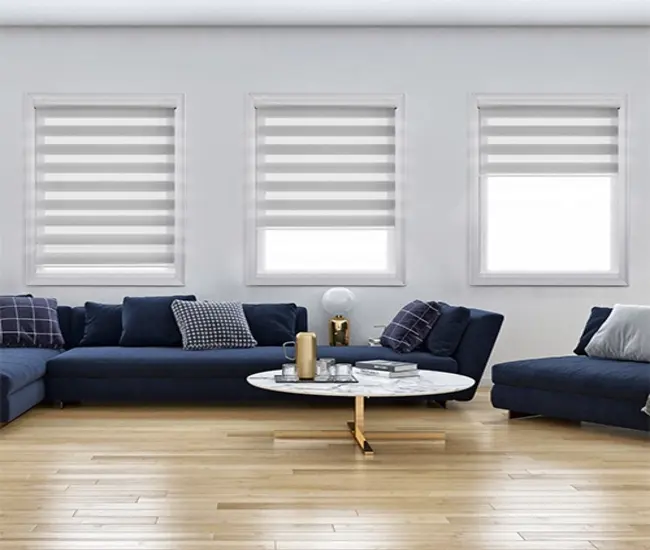
The main difference is their fabric construction. Zebra shades use two layers of fabric with alternating sheer and solid horizontal bands. As the fabric moves, the bands align or overlap to adjust light and privacy.
Sheer horizontal shades use soft fabric vanes suspended between two layers of translucent sheer material. Their vanes tilt open or closed while the shade remains lowered.
Choose zebra shades when you prefer a clean, striped appearance and distinct open-or-closed band alignment.
Choose sheer horizontal shades when you want softer styling, vane-like adjustment, and a more continuous filtered view through the window.
Zebra Shades vs. Sheer Horizontal Shades at a Glance

| Attribute | Zebra shades | Sheer horizontal shades |
|---|---|---|
| Construction | Alternating sheer and solid fabric bands | Fabric vanes suspended between sheer layers |
| Light adjustment | Bands slide into aligned or overlapping positions | Vanes tilt between open and closed positions |
| Appearance | Structured, graphic horizontal stripes | Soft, layered, fabric-vane appearance |
| View when open | View appears through aligned sheer bands | Filtered view through sheer layers and open vanes |
| Privacy position | Solid bands overlap | Fabric vanes close |
| Full opening | Fabric retracts into the headrail or cassette | Fabric and vanes retract into the headrail |
| Best suited for | Contemporary spaces and defined light settings | Softer interiors and gradual light adjustment |
| Nighttime privacy | Depends on band overlap and fabric opacity | Depends on vane closure, overlap, and opacity |
How Zebra Shades Work
A zebra shade—also called a banded, layered, or dual-layer shade—uses alternating strips of translucent and more opaque fabric. The fabric passes through the bottom rail so that the front and back layers move past each other.
When the sheer bands align, more light and a partial outdoor view pass through the shade. When the solid bands overlap the sheer sections, the shade provides greater coverage.
The bands do not tilt individually. You adjust light by raising or lowering the continuous fabric until the front and back bands reach the desired alignment. The complete shade can also be raised when you want an unobstructed window.
For a closer look at this operating system, review how day and night shades work.
How Sheer Horizontal Shades Work
Sheer horizontal shades contain soft fabric vanes held between two translucent fabric facings. With the shade lowered, the vanes can tilt into open, partially open, or closed positions.
When open, the vanes allow a filtered view through the sheer front and back layers. As they tilt closed, they cover more of the space between the sheer facings and increase privacy and light reduction.
The complete fabric assembly can retract into the headrail or cassette.
Unlike zebra shades, light control does not depend on aligning repeating solid and sheer bands. It comes primarily from changing the angle of the horizontal fabric vanes.
Which Provides the Better View?
Sheer horizontal shades generally create a more continuous filtered view when their vanes are open. The view still passes through the sheer fabric facings, but it is not divided by repeating opaque bands to the same degree.
Zebra shades create horizontal viewing areas wherever the sheer bands align. The solid bands remain visible, so the outdoor view appears in sections rather than as one continuous opening.
The actual view depends on:
- Width of the sheer openings
- Fabric color and weave
- Vane or band position
- Interior and exterior brightness
- Distance from the window
- Product dimensions
Order samples and hold them against the window rather than selecting a fabric from screen images alone.
Which Controls Light More Precisely?
Neither design is automatically better for every room; they adjust light in different ways.
Zebra shades provide defined alignment stages. Small movements change how much the sheer and solid bands overlap. They work well when you prefer recognizable brighter and more covered positions.
Sheer horizontal shades provide vane-angle adjustment. You can tilt the vanes gradually while leaving the shade at approximately the same height. This may feel more familiar to someone who prefers the light-control motion of horizontal blinds but wants a softer fabric construction.
With either design, “light filtering” does not mean blackout. Light may pass through the fabric, between sections, or around the shade’s edges. Review the opacity classification of the exact product before ordering.
Which Is Better for Privacy?
Both can provide adjustable coverage, but neither should be assumed to deliver complete nighttime privacy in every configuration.
For zebra shades, privacy increases when the solid bands fully overlap the sheer sections. Incomplete alignment can leave horizontal openings.
For sheer horizontal shades, privacy increases when the fabric vanes are fully closed. Visibility may remain through translucent material, insufficient vane overlap, or installation gaps.
At night, bright interior lighting can reveal silhouettes or movement through sheer material. Privacy should be evaluated using the exact fabric, not only the product style.
Review what people can see through sheer shades at night before choosing either design for a bedroom, bathroom, or street-facing window.
How Their Appearance Differs

Zebra shades have a more structured look. Their repeating horizontal bands become a visible design feature, making them suitable for contemporary rooms, offices, and spaces with clean architectural lines.
Sheer horizontal shades have a softer appearance. The floating fabric vanes and sheer facings create more visual depth and can complement living rooms, dining rooms, and formal spaces.
Color affects both styles. Light colors can appear brighter when illuminated from behind, while darker fabrics may emphasize the bands or vanes. Examine samples during the day and after turning on the room’s evening lights.
Cleaning and Everyday Care

Both products require gentler care than washable curtains or rigid slats.
For zebra shades, dust may settle on the horizontal fabric bands and within the layered material. For sheer horizontal shades, dust may collect along the fabric vanes and sheer facings.
If debris gets trapped between fabric layers, see how to remove dust and dead bugs from sheer fabric shades before attempting to reach inside.
Use a soft duster or a vacuum with a clean brush attachment and low suction when permitted by the manufacturer. Do not scrub, soak, or apply cleaning products without checking the fabric-care instructions.
General maintenance guidance is available in this guide to cleaning blinds and shades.
Neither design is ideal where it will be repeatedly exposed to grease, splashing water, sticky fingerprints, or aggressive cleaning.
Which One Is Better for Your Room?
Choose zebra shades if you:
- Prefer a modern, horizontally banded design.
- Want distinct sheer and covered settings.
- Do not mind a segmented outdoor view.
Choose sheer horizontal shades if you:
- Prefer a softer, less graphic appearance.
- Want to adjust fabric vanes by angle.
- Prefer a more continuous filtered view.
For either style, confirm the available control system, finished dimensions, mounting depth, fabric deductions, room-darkening level, and warranty before ordering.
Compare the starting cost of zebra and sheer horizontal shades, then consider whether sheer shades are worth the money for the features your room needs.
Final Answer
Zebra shades and sheer horizontal shades use different mechanisms to achieve a similar goal. Zebra shades align alternating sheer and solid bands, while sheer horizontal shades tilt fabric vanes suspended between sheer layers.
Zebra shades are usually the better fit for a structured contemporary look and defined band alignment. Sheer horizontal shades are generally better for softer styling, gradual vane adjustment, and a broader filtered view.
The right choice depends on how you want the shade to look when open, how you prefer to adjust light, how much nighttime privacy the room requires, and how the actual fabric performs at your window.
For further assistance, contact Blanca I. Martinez team for help at Affordableblinds.com.
Leave a Reply